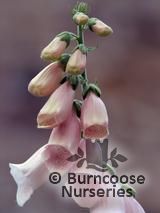
Digitalis lutea (common names: foxglove)

Latest photos of Digitalis lutea

  • Foxglove (Digitalis lutea (foxglove))
    By Tricky
  • Foxglove..Foxy pink (digitalis lutea)
    By Lori

Digitalis lutea (aka foxglove)


About us

Grows on You is a friendly gardening community for all levels of experience - and it's free to join!

Not convinced? Feel free to look around, visit our homepage, and be sure to check out the fantastic garden pictures.

Members growing this plant

  • joclark

    Joclark

    joined 12 Apr, 2008

    163 plants

  • Xela

    Xela

    joined 1 Mar, 2008

    218 plants

Comments on Digitalis lutea

Chrispook

Chrispook

21 Jun, 2008


Lovely shot.

On photo - Foxglove

flcrazy

Flcrazy

22 Jun, 2008


It looks like I'm peaking into a keliscope.

On photo - Foxglove

Lori

Lori

28 Jun, 2008


lovely foxy story...lol.

On photo - Foxglove

Lori

Lori

1 Jul, 2008


hmmm.... Did you by chance read a children's book from the fifties about two foxes, Tricky and Vixen? lovely kids book.

On photo - Foxglove

Tricky

Tricky

1 Jul, 2008


Hi Lori, not that I can recall... but now I am intrigued, tell more....

On photo - Foxglove

Lori

Lori

1 Jul, 2008


Author was George Cory Franklin, (could be a nom de plume...like Franklin W. Dixon for the Hardy Boys) He wrote 11 books but the ones I most admired and enjoyed where Tricky, Zorra and Tuffy... He writes about foxes with respect and admiration...Tricky and Vixen are Zorra's parents...and the humans in the story are miners, Happy Jack Ryan and Stevens... takes place in the American northwest....My grade five teacher read Tricky to us, chapter by chapter on Friday afternoons as a reward for working hard all week. That's why it seemed you were referring to the book with your name and the little fable of foxglove!! lol.

On photo - Foxglove

Members' notes...

joclark

Unknown colours, inherited and given space in front garden. Quite a few of them.

Xela

Seed sown 06.08 Vistabile

With their tall spires and dangling tube-like flowers, foxgloves add a free-and-easy cottage garden touch. They come in white, yellows, mauves, maroons and purples, many with beautiful speckles in the throat.

Foxgloves quickly form colourful clumps to liven up areas of light shade, attracting masses of bees. The common name has nothing to do with foxes. It's a corruption of the phrase 'folks' gloves' - fairy folk were said to use flowers as gloves. The Latin, digitalis, refers to the flowers' finger- or digit-like shape.

Besides buying or sowing the seed of a particular kind of foxglove, also buy a packet of mixed seed, to give all kinds of colours. But note that most foxgloves are biennials, which means you sow the seed one year; they flower, die and scatter seed the next. Also be aware that all parts of the plant are highly toxic if eaten, but handling them isn't a problem.

Digitalis purpurea: the only British native is the biggest and best, capable of reaching 1.8m (6ft) high. It has soft, felt-like leaves and a strong stem that can carry hundreds of tubular flowers. The buds are white; the flowers a rich, rosy purple with lovely speckles and clusters of short hairs in the throat. A biennial or short-lived perennial, it's best grown annually.

D. purpurea, Excelsior Group, has a wide range of pastel-coloured flowers that grow all around the stem, rather than only up one side. D. purpurea, Foxy Group, is much more compact and seldom exceeds 75cm (2.5ft) high. D. purpurea, subsp. heywoodii, meanwhile, is a wild subspecies with silvery leaves and ivory flowers. D. purpurea, Giant Spotted Group, is much more eye-catching, because of large blotches of dark purple in the flowers' throats. All are best grown annually.

D. grandiflora, closely resembling D. purpurea, has deep cream-coloured flowers whose throats are streaked with distinctive rusty markings. It's biennial or perennial. This plant been given the Royal Horticultural Society's Award of Garden Merit.

D. laevigata: in midsummer it produces spires of brownish-yellow flowers with a white lower lip and speckled interior. It's perennial.

D. lutea: a choice foxglove with slender stems of pale-yellow flowers from early to mid-summer - perennial.

D. x mertonensis: one of the most popular forms, its dusky pink flowers are large, but the stems slightly shorter than those of D. purpurea. Although a hybrid, it produces fertile seed that replicates the parent. It's perennial. This variety has also been given the AGM.

D. parviflora: has early summer, dark orange-brown flowers which are densely packed along the flower spikes - perennial.

Growing tips

Site and soil preferences:
Virtually any soil is fine. It should ideally being quite rich, but avoid wet and dry extremes, and grow in light shade.

Sowing:
The optimum time to sow seed is as it matures on the plant in mid to late summer, before the end of August. A single seed capsule will provide hundreds of seeds, a few of which can be sown in ordinary seed compost, in containers, and placed somewhere cool and moist. The seedlings will produce large, early flowering plants for next summer. If you're relying on nature to do the work for you in borders, thin out the seedlings on the ground to enable them to reach a decent size. In a wild garden, don't intervene; higgledy-piggledy is fine.

Problem solver

Powdery mildew can be a problem, but foxgloves are remarkably resilient and don't require any pampering.

Our A to Z of garden plants

Looking to buy plants? Compare prices and reviews across garden shops.